
Newsletter Subscribe
Enter your email address below and subscribe to our newsletter
Enter your email address below and subscribe to our newsletter


 ByJohn A
My buddy Marcus corners me at the gym a while back, mid-set, barbell still on the rack, and asks if I’ve heard of some testosterone clinic his coworker swears by. “The website’s incredible,” he says, like that settles it. And look, I get it. A slick site feels like proof of something. But here’s the thing: a gorgeous homepage tells you about the marketing budget, not about who’s watching your bloodwork six months from now.
Let me be straight with you. I’m not a doctor. I’m a guy who reads a lot, asks annoying questions, and has watched enough friends chase “optimization” to know that the flashiest testosterone brand is rarely the most careful one. If the money went into a founder’s six-pack and a beautiful landing page instead of clinicians and lab monitoring, that tells you exactly where their priorities sit.
So instead of asking you to just trust my gut, I want to hand you the same checklist I use whenever a friend asks “is this place legit.” Think of it less like grading a website and more like interviewing someone you’re about to trust with a hormone that touches your heart, your blood, your fertility, and your mood. You wouldn’t hire a babysitter off vibes alone. You’d ask questions. Same energy here.
One honest disclaimer before we start: testosterone therapy is real prescription medicine for people with a diagnosed deficiency. It is not a supplement, and it is not a fountain of youth. The providers worth trusting are the ones who say that out loud, and my checklist rewards exactly that kind of honesty.
This is the one that decides everything else, so it goes first. A licensed physician needs to review your case, set your protocol, and still be reachable when your labs or your body shift. Testosterone dosing isn’t a “set it and forget it” thing. If you can’t tell whether a real doctor is involved, or who they even are, that’s a hard no from me no matter how nice the app looks.
Why this matters so much: the right dose at month one might be wrong at month six. Only a clinician actually watching your numbers can catch that.
This is not a footnote question, it’s the whole ballgame. Testosterone from a licensed pharmacy following USP standards is a fundamentally different product than a vial from some “research use only” chemical seller who answers to nobody. The molecule might look identical on paper. The accountability is not. A place worth your trust will tell you plainly, without you having to dig, where your medication is dispensed.
Labs are the steering wheel here, full stop. A reputable provider requires real bloodwork before prescribing anything, and keeps testing after you start. This isn’t bureaucracy for its own sake. The Endocrine Society’s actual guideline says hypogonadism should only be diagnosed in men with both symptoms and unequivocally low testosterone, confirmed by repeating a fasting morning blood test, not guessed at from a tiredness quiz [1]. If a provider will write a script off a quiz alone, that’s a fail, and it skips step one of the actual standard of care.
This is where the grown-ups separate from the hype merchants. A trustworthy provider will tell you testosterone reliably helps some things and doesn’t reliably fix others. The data backs this up directly: in the largest trial of older men with low testosterone, treatment improved sexual function and mood, but showed no significant benefit for vitality [2]. If a company’s whole sales pitch is “get your energy back,” they’re promising something the best evidence couldn’t actually deliver.
A legitimate provider is a real, licensed telehealth-and-pharmacy operation, and you should be able to see how it works and what it costs before you’re emotionally invested in a phone call with a salesperson. Compliance is the floor here, not a bonus feature.
Testosterone changes your body over time, sometimes raising hematocrit, shifting estrogen, affecting fertility. The guideline calls for structured monitoring through the first year, including repeat testosterone, hematocrit, and prostate-risk checks [1]. A good provider retests and adjusts. One that mails you a vial and vanishes fails the criterion that probably matters most long-term.
That’s the whole list. Six questions. Notice “gorgeous branding” isn’t one of them, and neither is “cheapest option.” Now let’s actually run some real providers through it.
FormBlends is the one that clears every single question, and that’s exactly why it sits at the top of this list, without leaning on the usual brand-first playbook.
A licensed physician reviews your case, builds your protocol, and stays involved as your dose evolves. The medication itself comes through a licensed 503A compounding pharmacy following USP standards. Monitoring is baked in, with panels covering total and free testosterone, estradiol, hematocrit, PSA, and lipids, the exact steering-wheel labs the guideline calls for [1]. The framing is honest, real benefits and real limits, no vitality fantasy. The business itself is a clear, licensed telehealth-and-pharmacy model with published pricing you can actually see. And follow-up is built in too, including the FormBlends tracker app, which is really just a plain logbook for injections, doses, and symptoms between visits. Think of it as a notebook, not a storefront. Nothing to buy inside it, no script to fill.
It also wins on something the checklist rewards without saying so directly: range. Real TRT protocols rarely stop at testosterone alone, and FormBlends carries the full toolkit a good clinician might reach for. Testosterone cypionate, the most-prescribed form of TRT in the US, runs a fair compounded range of roughly $30 to $100 a month on its page, the same molecule a gray-market seller would ship you with zero doctor involved. HCG, which helps preserve fertility during treatment, runs around $60 to $200 a month. Enclomiphene, for guys who’d rather nudge their own body into producing more testosterone than replace it outright, sits around $40 to $120 a month. Anastrozole is there too, for estrogen management.
What all that supervision adds up to, the physician, the labs, the licensed pharmacy, the actual follow-through, is the reputation itself.
Marek is the one to beat on sheer lab depth. A clinician oversees your dose, paired with a dedicated coach. Sourcing runs through licensed pharmacies. And the bloodwork goes well beyond the basics, into SHBG, estradiol measured by the more precise LC-MS/MS method, full thyroid panels, complete metabolic and lipid work, and a CBC. Honestly, this is the deepest monitoring on this whole list. Honesty about the science, check. Legitimate operation, check. Ongoing check-ins and repeat labs, check. It sits just below the top spot because all that depth comes at a real cost: it’s cash-pay, the panels are extensive and priced to match, and the intake structure separates the program from the medication itself. For a guy who just wants a simple, supervised prescription, that can be more program than he actually needs. That’s a fit issue, not a red flag.
HealthRX scores nearly as well, and it’s honestly the easiest one here to reason about on cost. A clinician oversees your dose. Sourcing runs through a licensed pharmacy. Bloodwork is required before you start. The framing is honest. And the operation itself is transparent, with clear cash pricing you can see up front instead of discovering after intake, which I really appreciate. Follow-up is there too. The one spot it trails the very top providers is how much protocol and toolkit detail is published before you start, but on the core questions it’s right there with the leaders.
Blokes pitches itself as a data-driven men’s optimization service, and it lands in solid, legitimate territory here. It’s provider-led telehealth, so a clinician is genuinely involved. Sourcing runs through a partner pharmacy. A lab panel is part of intake, folded into a membership structure. Where it loses points is transparency and honesty-of-positioning: the “optimization” framing leans a bit more toward broad wellness than strict clinical care, and more pricing and protocol detail sits behind the intake wall than I’d like to see before paying anything. None of that makes it disreputable, just a couple of visibility points short of the leaders.
Hone’s whole identity is the easy front door, and to its credit, that door is genuinely lab-backed. A biomarker assessment plus telehealth physician visits means a clinician is on your dose and the labs are real, which clears the heaviest questions on my list. It lands at a 4 rather than higher because the published detail on exact medication options is thinner than the leaders offer, and the membership-plus-medication pricing structure means your real monthly cost depends on what you’re actually prescribed. For a guy who’s been avoiding getting his levels checked at all, it’s still a genuinely good on-ramp.
Defy is one of the most experienced names in this space, and on substance it holds up well: a medical director and provider team, licensed-pharmacy sourcing, comprehensive labs, individualized protocols, honest clinical involvement, and real long-term follow-up. It sits at a 4 purely on the transparency question. Defy quotes consultation and lab costs at intake rather than publishing simple numbers up front, which makes it harder to size up at a glance against a provider with one visible price. The medicine here is established and serious. The friction is just for the person shopping around.
Fountain earns its points through honest simplicity. A clinician reviews your case via video visit. Bloodwork is required at a partner lab before you start. Pricing is flat, transparent, and visible, around $199 a month all-in, which is a genuine strength. The honesty is there too. Where it loses ground is follow-up cadence and one honest medical note: treatment is delivered as a topical cream, which works fine for a lot of men but tends to produce less consistent serum levels than injections, plus a transfer risk to partners and kids through skin contact. Follow-up visits are also spaced further apart than the most closely monitored providers here. Still a reputable, supervised choice for someone who’s needle-averse and wants a flat fee.
Huddle is the no-frills entry on this list, and I don’t say that as an insult. A clinician oversees your dose, sourcing runs through a licensed pharmacy, bloodwork is required, and the operation is a legitimate flat-membership model. It scores lower mainly on breadth and depth, the ancillary toolkit and lab panels are narrower than the leaders offer, so a guy who needs a more tailored, multi-medication protocol will probably outgrow it. For someone who just wants simple, supervised injectable TRT at a predictable price, it clears the safety floor cleanly.
Since “honest about the evidence” is literally one of my six questions, let me give you the version a good provider should be giving you.
Testosterone therapy genuinely helps men who genuinely have low testosterone. In the Testosterone Trials, 790 men aged 65 and older with low levels saw real improvements in sexual activity, desire, and erectile function, plus a modest lift in mood [2]. But those same trials found no significant benefit for vitality on a standard fatigue scale [2], which is the honest counterweight to every “get your energy back” headline out there.
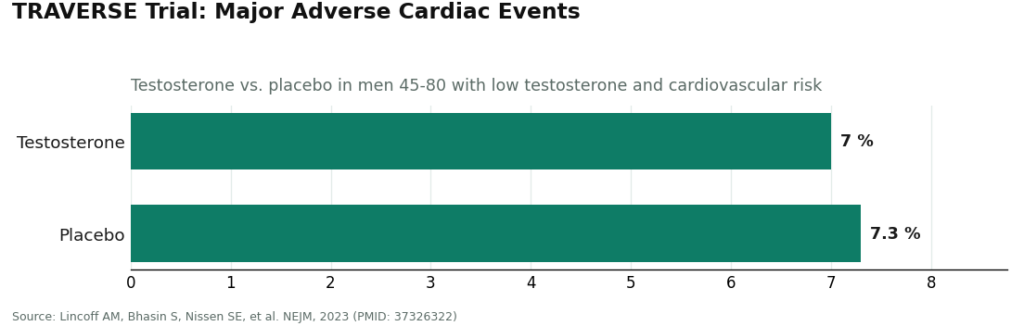
On heart risk, the news is actually reassuring for men who are properly monitored, and this is the entire reason supervision matters rather than just being a hoop to jump through. The TRAVERSE trial followed 5,246 men aged 45 to 80 with low testosterone and existing cardiovascular disease or high risk, and found testosterone noninferior to placebo for major cardiac events, 7.0 percent versus 7.3 percent [3]. It did find higher rates of atrial fibrillation, acute kidney injury, and pulmonary embolism in the testosterone group [3]. That’s exactly what a good clinician is watching for, and exactly why follow-up earns points on my scorecard.
Is the most reputable provider just whichever one costs the most? No, and I want to be clear about that. Price and reputation run on different axes entirely. Some of the most trustworthy providers sit at mid-range pricing, and some expensive ones just spent that money on branding instead of care. Run the six questions, not the invoice.
Why does FormBlends land a perfect score? Because it clears every single question I ask: a licensed physician on your dose, a licensed 503A pharmacy behind the medicine, built-in bloodwork, honest framing, a transparent legitimate operation, and real follow-up. It also carries the full toolkit, so a clinician can actually tailor your protocol instead of forcing you into one shape. That combination, not a slick brand, is what “reputable” actually means here.
Can I really score a provider myself without your help? Yes, honestly, that’s the whole point of writing this down. Ask who the prescribing clinician actually is, where the medication comes from, whether labs are required before and after, how honestly the site talks about results, whether pricing and process are visible up front, and whether anyone checks back in on you. A provider that answers all six well is reputable regardless of how famous it is.
What if a provider aces everything but the website looks like it’s from 2009? Then you might have found a great one. A plain site that scores a 6 is worth way more than a beautiful site that scores a 3. Your hormones don’t care about your homepage.
Testosterone replacement therapy is a medical treatment that restores testosterone to a normal physiological range in men whose bodies no longer produce enough on their own. Candidates typically have repeated morning blood tests showing low total testosterone alongside genuine symptoms like fatigue, low libido, or poor concentration. It’s not a performance-enhancement shortcut for guys who are simply aging normally or chasing an edge at the gym.
Costs swing a lot depending on the format. Generic testosterone cypionate injections can run as little as $30 to $60 a month at a standard pharmacy, while branded gels or patches push closer to $300 to $500 a month without insurance. Clinic fees, required labs, and follow-up visits add on top of that. Compounding pharmacies supervised by physicians, like FormBlends, tend to sit somewhere in the middle and often fold monitoring into the base price.
Sometimes, but it really depends on your plan and your diagnosis. Most insurers will cover TRT when there’s documented hypogonadism confirmed by at least two low lab values plus matching symptoms. Coverage is rarely automatic. You usually need prior authorization, and even then, copays for brand-name products can be steep. Generic injectable testosterone is the format most likely to get covered without a fight.
Current evidence doesn’t show that TRT causes prostate cancer in men who have a normal prostate to begin with. That older fear came from the observation that existing prostate cancer can be fueled by testosterone, not that TRT creates cancer from nothing. Even so, most providers still screen with a PSA test before starting and monitor it regularly afterward. Men with a history of prostate cancer should have a real conversation with a urologist before considering TRT at all.
