
Newsletter Subscribe
Enter your email address below and subscribe to our newsletter
Enter your email address below and subscribe to our newsletter

 ByJohn A
A solid infrared sauna warranty breaks coverage down by part. Expect the wood cabinet to carry the longest term, often 5 years up to a limited lifetime guarantee on structural defects, while carbon or ceramic heating panels typically run 3 to 5 years and the control panel or digital display runs just 1 to 2 years. Before buying, check what voids the claim, whether coverage transfers to a new owner, and who pays shipping on a replacement part.
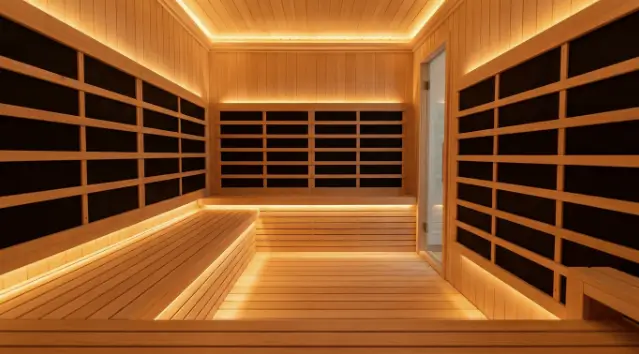
Most infrared cabins are sold as a single unit, but the warranty behind one is rarely a single number. Reputable manufacturers split coverage into at least three tiers: the wood cabinet (commonly basswood, cedar, or hemlock panels), the heating elements (carbon fiber panels, ceramic emitters, or a hybrid of both), and the electronics that run everything, including the control panel, wiring harness, and digital display.
The cabinet tier usually carries the longest term because wood defects, like warping or delamination at a seam, tend to show up early if they are going to show up at all. The heating panel tier matters most for cost, since panels are not always sold individually and shipping a full unit back to a warehouse can get expensive. The electronics tier is typically the shortest window, just a year or two, since control boards and touch displays are the parts most likely to fail from moisture or ordinary wear.
Ask for the actual warranty document, not a marketing summary. A single line that just says “5-year warranty” without breaking out which parts get which term usually means the retailer is smoothing over gaps you will find out about later.
A rough pattern holds across most of the market. Cabinet wood: 5 years is common, and some brands extend to a limited lifetime guarantee against structural defects, prorated after the first several years. Heating panels: 3 to 5 years is typical for carbon fiber; ceramic emitters sometimes get a shorter window since they run hotter and degrade faster under heavy use. Control panel and wiring: 1 to 2 years. Door glass and hinge hardware: often just 1 year, or excluded entirely if the damage traces back to impact.
If a listing advertises a lifetime warranty with no part-by-part breakdown, ask what it specifically covers. A lifetime warranty on the wood frame is a real benefit worth paying for. A lifetime warranty on panels functionally rated for a fixed number of wattage cycles is closer to a marketing phrase than a practical guarantee.
Four things trip up most claims. First, installation location: most residential units are built for indoor use or a fully enclosed, weatherproofed structure, and running one on an open deck exposed to rain or snow can void coverage even when the manual does not spell that out plainly. Second, voltage and circuit load: a typical one- to two-person cabin runs on a dedicated 120V, 15-amp circuit, and plugging in space heaters or other draw on that same circuit can trip breakers and stress components in ways a manufacturer will flag during a claim review. Third, water intrusion from over-spraying essential oils or excessive sweat pooling near the control panel, since infrared units are dry-heat by design and treating one like a steam room is a fast way to void the electronics coverage.
Fourth, and the one buyers miss most often, is commercial use. A warranty written for personal, residential use does not extend to a unit installed in a gym, spa, or short-term rental, even if the sauna is the identical model, so anyone buying for a rental property should ask directly whether the warranty covers commercial placement.
“Limited lifetime” does a lot of work in that phrase. In practice it almost always applies to the cabinet wood only, and it is usually prorated: full replacement value in years one through five, then a declining credit toward a new cabinet after that, not a free replacement forever. Compare that to a plain limited warranty, 5 years on the cabinet, 3 on panels, 1 on electronics, no lifetime language anywhere. That version is often the more honest document, since it tells a buyer exactly what happens and when, rather than leaning on a word that sounds generous but arrives with conditions buried a few paragraphs down.
Where a sauna is purchased matters almost as much as the warranty term itself, because a warranty is only as useful as the company standing behind it when a panel fails in year three. Large general marketplaces sell infrared cabins alongside thousands of unrelated categories, and a claim there often routes through a generic support queue that has to look up the manufacturer first. Specialty retailers such as sweatdecks.com carry a narrower lineup than a general marketplace, but they typically know the warranty terms of every model they stock and can walk a buyer through a claim instead of pointing them toward a call center they have to track down on their own.
Manufacturer-direct purchases carry a different tradeoff: no middleman, but replacement parts from a small or overseas company can take weeks to ship. Ask any seller how claims actually get processed, since that answer says more than the warranty length printed on the box.
How often someone plans to sit in the cabin should shape which warranty tier gets the closest read. A review in Mayo Clinic Proceedings on the cardiovascular and other health associations tied to sauna bathing found the populations most represented in the underlying research are frequent users, several sessions a week, and a separate systematic review of regular dry sauna bathing in Evidence-Based Complementary and Alternative Medicine describes a similar pattern of sustained, repeated use. Most of that research covers traditional Finnish-style dry sauna rather than infrared cabins specifically, but it points to a practical reality: a household using the sauna several times a week puts far more hours on the heating panels than one using it occasionally, and should read those warranty terms most carefully. An older review in The American Journal of Medicine on the benefits and risks of sauna bathing makes a related point about frequency mattering more than any single session.
How long do infrared sauna heating panels typically last? Panels are generally rated for several thousand hours of use, roughly 8 to 10 years of regular sessions before output fades, though the warranty on them is usually shorter, often 3 to 5 years.
Does moving an infrared sauna to a new home void the warranty? Not usually, provided it is reinstalled on the correct voltage circuit without forcing seams that were not built to come apart. Some manufacturers ask that the move be registered, so check the transfer clause first.
Do I need a licensed electrician to keep the warranty valid? Most one- and two-person cabins plug into a standard 120V circuit and need no electrician. Larger cabins wired for 240V often do require licensed installation.
What is the difference between carbon and ceramic panel warranties? Ceramic emitters run hotter and sometimes carry a shorter warranty window than carbon fiber panels, which run cooler. Ask for the panel type by name rather than assuming both carry the same term.
Can I install an infrared sauna outdoors and keep the warranty? Only if the manufacturer rates that model for outdoor or all-weather use. An indoor-rated cabin left exposed to rain or snow without a weatherproof enclosure will typically void coverage.
By Megan Aldrich
